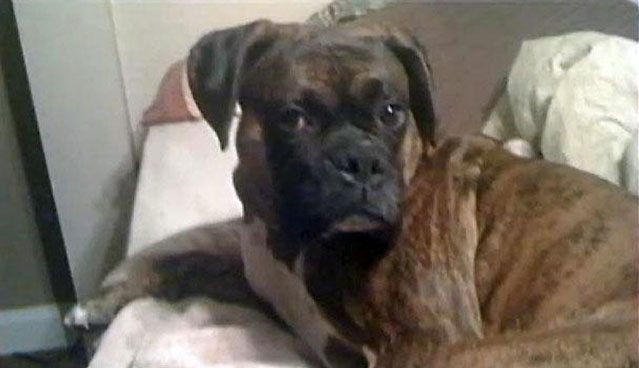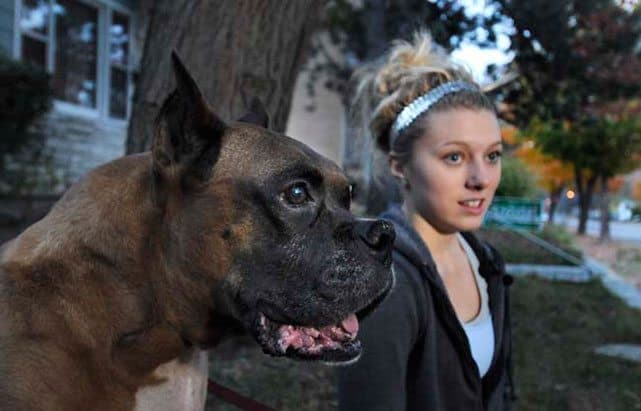
Fishing Boxers?: Video

Admin: Kenn Bell
Categories: Fun Videos, News

Click to join our Facebook Fan Page and follow us on Twitter!


Post to Twitter Post to Facebook Post to StumbleUpon

Best Friends: Video

Admin: Melody Chen
Categories: Fun Videos, News

Click to join our Facebook Fan Page and follow us on Twitter!


Post to Twitter Post to Facebook Post to StumbleUpon

Boxer Balancing Acting: Video

Admin: Melody Chen
Categories: Fun Videos, News

Click to join our Facebook Fan Page and follow us on Twitter!


Post to Twitter Post to Facebook Post to StumbleUpon

Buster The Boxer Doesn’t Like To Be Told To Be Quiet: Cute Video

Admin: Kenn Bell
Categories: Fun Videos, News

Click to join our Facebook Fan Page and follow us on Twitter!


Post to Twitter Post to Facebook Post to StumbleUpon

Dog Files Fact: Boxer

Admin: Kenn Bell
Categories: Breed, Dog Files Fact, History, News

Boxer_Puppies

The Boxer originates from Germany and was bred originally for a variety of tasks including hunting wild boars, deer and small bears and bull baiting.

Although it has reached its greatest perfection in Germany during the past hundred years, the Boxer springs from a line of dogs known throughout the whole of Europe since the 16th century. Prior to that time, ancestors of the breed would hardly be recognized as Boxers could they be placed beside modern specimens. Still, evidence points to the Boxer as one of the many descendants of the old fighting dog of the high valleys of Tibet.

The Boxer is cousin to practically all recognized breeds of the Bulldog type, and these all go back to basic Molossus blood. Few other strains can claim such courage and stamina; and from this line emanates the attractive fawn color that has recurred throughout the centuries.

Flemish tapestries of the 16th and 17th centuries show scenes of stag and boar hunting; the dogs are the same as the Spanish Alano, found in great numbers in Andalusia and Estramadura, and the Matin de Terceira or Perro do Presa, from the Azores. The Alano and the Matin have been regarded as the same breed-they are either ancestors of the Boxer or they trace back to a common ancestor.

In France, there is a breed known as the Dogue de Bordeaux that is very close both in appearance and size to the old Tibetan Mastiff, and it is from this massive dog that the Bouldogue de Mida was developed. The Bouldogue du Mida, found principally in the south of France, possesses many of the points of the Boxer.

While all the European breeds mentioned are related to the Boxer, this favorite of Germany has been developed along scientific lines that not only have succeeded in retaining all his old qualities, but have resulted in a much more attractive appearance. Besides Bulldog blood, the Boxer carries a certain heritage from a terrier strain. There is also some reason to believe that English Bulldogs were at one time imported into Germany. Indeed, Reinagle’s noted Bulldog, done in 1803, is not unlike the Boxer, and pictures of some English specimens of 1850 are almost identical with the German dog.

The first AKC registration of a Boxer was in 1904, and the first championship was finished in 1915, but it was not until about 1940 that the American public began to take a real interest in the breed. This came about because of the consistent Group and Best in Show wins scored by some outstanding Boxers.

There are several theorise relating to how the Boxer got his name. The most common is that the names derives from fighting and playing with its front paws. The lesser known theory is that the breed was once called ‘Boxl’ and ‘Boxer’ is a corruption of this word. This dog is classified as one of the Working Dog Group.

Boxers are a bright, energetic and playful breed and tend to be very good with children. They are active dogs and require adequate exercise to prevent boredom-associated behaviors such as chewing or digging. Boxers have earned a slight reputation of being “headstrong,” which can be related to inappropriate obedience training. Owing to their intelligence and working breed characteristics, training based on corrections often has limited usefulness. Boxers, like other animals, typically respond better to positive reinforcement techniques such as clicker training, an approach based on operant conditioning and behaviorism, which affords the dog an opportunity to think independently and to problem-solve.

BoxerHead

Post to Twitter Post to Facebook Post to StumbleUpon

Dog Groomers Use CPR to Rescue Pooch

Admin: Kenn Bell
Categories: Dog Safety, Lifestyle News, News

By ANDREW GREINER for NBC Chicago

Benny looked like a goner.

The 8-year-old boxer collapsed at the Biscuits and Bows pet grooming facility in Palatine. He had no pulse and he wasn’t breathing.

But thanks to a quick thinking pet massage therapist the pooch will be just fine, according to the Daily Herald.

Laurie Kay administered dog CPR and resuscitated the animal. If you think that’s odd, you may be surprised to hear that Kay actually has canine-CPR training.

“Even though I’ve been trained in CPR for people and for dogs,” Kay told the Daily Herald. “I never thought I’d have to use it.”

“It was an out-of-body thing. I just did it,” Kay says. “Only it was different than in class. In class, we practiced on dog dummies. This was almost like doing it on a person. It was much more intense. I felt like each compression was important.”

Kay’s partner at the salon, Donna Stepanek, said performing mouth-to-mouth on a slobbery dog is no easy task.

“I had to grab all his jowls and cup my hands completely around his mouth and nose in order for the air to go in,” Stepanek said.

Kay and Stepanek kept up the regimen of mouth-to-mouth and 15-chest compression cycles for five minutes before Benny came to.

Benny’s owners are ecstatic, but they still have cause for concern. The dog was diagnosed with Boxer cardiomyopathy, a weakened heart, after the incident. His treatment cost $2,000.

Post to Twitter Post to Facebook Post to StumbleUpon

First Cancer Drug For Dogs Approved By FDA

Admin: Kenn Bell
Categories: Health & Science News, News

by Suzan Gridley, i Love Dogs

The first cancer treatment drug specifically designed for dogs has been approved by the FDA. The drug has been named Palladia, a word which has roots to classical Mythology and the goddess Pallas, who is associated with protection. Palladia, manufactured by Pfizer Animal Health Inc, has been found to successfully treat mast cell tumors by cutting off the blood supply to them, thus preventing metastasis to other parts of the body, including the lymph system, which can occur with this form of canine skin cancer. The drug can be used effectively with or without lymph node involvement.

Mast cell tumors account for about 20% of canine skin cancer. They are usually seen as solitary lumps or masses in or under the skin, but can occur in a wide range of sizes and appearances. Currently, surgical removal has been the primary method of treatment. However, because of their locally invasive behavior, wide margins of what appears to be normal tissue around the tumor need to be removed to increase the likelihood that the tumor has been completely removed.

The Boxer is at an especially high risk for mast cell tumors, as are related breeds like the English Bulldog and Boston Terrier. Also at higher than average risk are the Shar pei, Labrador Retriever, Golden Retriever, Schnauzer, and Cocker Spaniel.

Palladia, a tyrosine kinase inhibitor, works on individual tumor cells to kill these abnormal cells. It also acts on the blood vessels which supply the mast cell tumor(s). It is meant to be used for dogs with recurrent tumors and those who are staged as grade II or III. Possible side effects include: depressed appetite or refusal to eat, vomiting, diarrhea, fresh blood in vomit or feces, dark, tarry feces, or abnormal or unexplained bruising or bleeding.

Pfizer is scheduled to begin selling Palladia in early 2010, but the price has not yet been announced. If your dog is covered by pet health insurance, you can expect the terms of coverage to be similar to existing treatments. Jennifer Neal, spokesperson for Pets Best Insurance, advises that their policies pay for 80% of the cost after the deductible, up to the per incident limit. Per incident limits vary per policy; Ms. Neal indicated that the cost for existing cancer treatments seldom exceeds $6,000. She also suggested that pet owners purchase insurance when their pets are young since pre-existing conditions are not covered.

Post to Twitter Post to Facebook Post to StumbleUpon

Baby & Boxer Video On Bonnie Hunt Show

Admin: Kenn Bell
Categories: Fun Videos, Lifestyle News, News

Very cute video of an infant playing with a Boxer.

Post to Twitter Post to Facebook Post to StumbleUpon

Dog Braves Staten Island Traffic To Guard Dead Companion

Admin: Kenn Bell
Categories: News

This comes from silive.com

bravestdoginsi

They didn’t have names, they no longer had a home, and this afternoon they no longer had each other.

Two brown-coated boxer dogs, alone on an isolated stretch of Richmond Terrace in Mariners Harbor, likely strayed into traffic. One animal was struck and killed; the other, loyal to its companion, defied vehicles to protect the body

“They were definitely connected,” speculated an onlooker. The dead dog was female and its protector male.

A subsequent examination of the dead dog revealed that she was about a year old and had borne puppies.

The sad spectacle struck a chord with people who happened on the scene, in front of the Mariners Marsh Park Preserve. Some provided food and water, others imparted gentle touches and kind words to the sentinel dog, and still others sought to divert traffic.

“I was playing cop,” said Michael Olivo, 50, of West Brighton.

He and his wife, Jeannie, 44, and their daughter Angela were returning from a shopping expedition to New Jersey about 2:45 p.m. when they spied the dogs. Cars already were starting to back up in both directions as they negotiated the site.

Angela, 16, noted that the male was extremely protective of the body. “He wasn’t aggressive, but he let out a low growl if you got too close,” she said.

Mrs. Olivo said that while her husband directed traffic, she used her cell phone to call city agencies, including Animal Care and Control. She complained that the workers to whom she spoke were rude and unresponsive to the boxers’ plight.

Finally, Fire Department personnel arrived and moved the dog’s body to the side of the road.

At about 5 p.m., Sgt. Raul Morales of the Port Authority Police responded. He called for backup, and P.O. Kwok Chung and another officer responded. After they chased the male boxer for a few minutes with a snare, the dog ran over to the Olivos and others. A man identified only as Michael calmed the animal and it submitted to having a red leash put on it.

“He knows the deal. [He'd] rather go with these people,” said Morales.

The police removed the male to Animal Care and Control in Charleston.

Meanwhile, Mrs. Olivo had summoned her sister, Elizabeth Aguilar of Mariners Harbor. She called her friend Pegeen Nelson of Strictly Strays, who scooped up the female’s body for transport to the Charleston site.

Dead animals are the responsibility of the city Department of Sanitation.

A call to Animal Care and Control last night was not returned.

Mrs. Olivo had praise for the Port Authority Police: “They were the only agency that would help us. They were courteous, polite, and they cared about the well-being not only of us, but of the dogs.” 
The site where the dogs came to grief is hard by the Goethals Bridge and near the New York Container Terminal at Howland Hook.

– Contributed by Kiawana Rich

Post to Twitter Post to Facebook Post to StumbleUpon

Second Chance

Admin: Kenn Bell
Categories: Adoption Files, Episodes

The Dog Files is proud to premiere the first episode of the “The Dog Files Hit The Heartland” series. It’s called “Second Chance” and it’s about a Rescue Shelter in Sioux Falls, South Dakota called, you got it, Second Chance Rescue Center.

We would like to thank Rosey Quinn for letting us spending the day chronicling all the great work they do for all animals, big and small!

Next Episode: Pitt Proud!

The Dog Files turn the tables on the pitbull myth by showcasing a pitbull named Hector, formally owned by dog villian, Michael Vick.


Post to Twitter Post to Facebook Post to StumbleUpon

“Heartland” Trailer

Admin: Kenn Bell
Categories: Episodes

The Dog Files is proud to announce a four-part series starting in March 2009 entitled “The Dog Files Hit The Heartland.”

Back in October 2008, The Dog Files had the pleasure to travel to Minnesota and South Dakota and get a first hand look at the Dog Shelter/Adoption situation in America’s great Midwest. We came away with the knowledge that so many caring, loving individuals are giving their all to help man’s best friend in the heartland and we can’t wait for you to see our four, very special episodes.

So check out the “Heartland Trailer” and stay tuned to our website this Spring to hit America’s Heartland with The Dog Files! It’s gonna be a great ride!

Hector the Pitbull

Post to Twitter Post to Facebook Post to StumbleUpon

The Dog Files Hit The Heartland!

Admin: Kenn Bell
Categories: Dog Files News, News

The Dog Files is proud to announce a four-part series starting in March 2009 entitled “The Dog Files Hit The Heartland.”

Back in October 2008, The Dog Files had the pleasure to travel to Minnesota and South Dakota and get a first hand look at the Dog Shelter/Adoption situation in America’s great Midwest. We came away with the knowledge that so many caring, loving individuals are giving their all to help man’s best friend in the heartland and we can’t wait for you to see our four, very special episodes.

So check out the “Heartland Trailer” and stay tuned to our website this Spring to hit America’s Heartland with The Dog Files! It’s gonna be a great ride!

Related Posts with Thumbnails

Post to Twitter Post to Facebook Post to StumbleUpon

The Dog Files are TM & © 2010 GraphicPlanet Creative