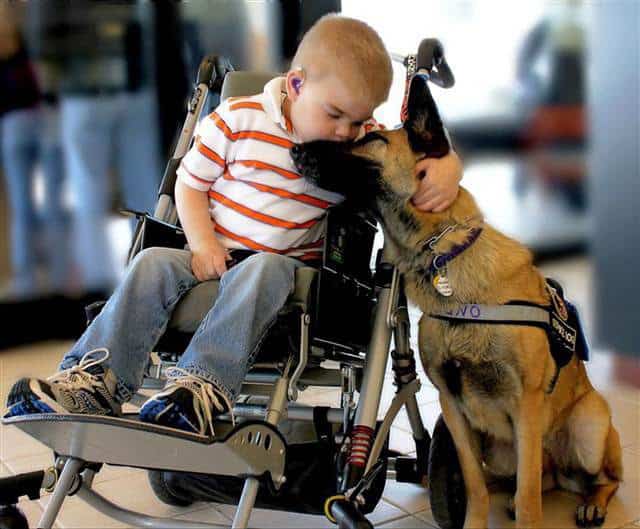
Service Dogs Taking Care Of Iraq War Veterans

Admin: Kenn Bell
Categories: Lifestyle News, Military, News, Service Dogs

Click to join our Facebook Fan Page and follow us on Twitter!


Post to Twitter Post to Facebook Post to StumbleUpon

Therapy Dog ‘Dangerous’? Elgin Targets Pit Bulls, Other Breeds

Admin: Melody Chen
Categories: Breed-Specific Legislation, Legal News, News, Service Dogs

Click to join our Facebook Fan Page and follow us on Twitter!


This kinda stuff scares me. What do you guys think?

– Kenn

By Amanda Marrazzo for Chicogo Tribune

Elgin, Illinois — Elgin’s effort demonstrates the difficult balance for communities in trying to protect citizens from dog attacks while avoiding the outcries — and potential lawsuits — from those who say pit bulls are unfairly demonized.

Joe Remijas dresses up his dog Taysia with feather boas and paints her toenails when he takes her on weekly visits to a nursing home and hospital in Elgin.

A certified therapy dog, Taysia has brought cheer to hundreds of ill and elderly people over the past seven years, he said.

Taysia is also a pit bull. So in order to keep her, Remijas will likely have to secure $100,000 in liability insurance and post a “dangerous dog” sign on his property, restrictions the Elgin City Council will impose on dangerous and vicious dogs if an animal control ordinance it is considering becomes law. The measure narrowly won preliminary approval last week.

The proposal doesn’t ban pit bulls outright but does classify them as dangerous. Other breeds would only be labeled dangerous if they attack a person or another animal, or vicious if the victim is seriously hurt or killed.

To read more click here.


Post to Twitter Post to Facebook Post to StumbleUpon

Maryland Girl’s Service Dog Takes Classmates’ Focus Off Her Cerebral Palsy

Admin: Melody Chen
Categories: Lifestyle News, News, Service Dogs, Working Dogs

Click to join our Facebook Fan Page and follow us on Twitter!


By Patricia M. Murret for The Gazette

Michelle Brown was apprehensive when her parents talked to her about getting a canine assistant to help her in school. But Sylvia, a golden retriever-yellow Lab mix, has changed her life, 13-year-old Michelle said.

“She has changed my life because it makes it easier for me to go to school — and know that everybody likes me a lot more, and they don’t pay attention to my disability as much,” said Michelle, who has seizures from cerebral palsy. “She’ll never judge me. She’ll always want to help me, and she will do whatever she can to make me happy.”

Sylvia is known among teachers and students at John T. Baker Middle School in Damascus, where Michelle is an eighth-grader, although she has not attended this school year because of a hip injury.

To read the rest click here.

Post to Twitter Post to Facebook Post to StumbleUpon

UK Police Seek Redemption After Dog Deaths

Admin: Melody Chen
Categories: Dog Safety, Entertainment, Inhumane Practices, Lifestyle News, News, Service Dogs, Working Dogs

Click to join our Facebook Fan Page and follow us on Twitter!


By Anthony Bartram for BBC News

When you see a German Shepherd dog chase down and tackle a criminal, there can be little doubt they are highly trained. But highly valued?

It is a question Nottinghamshire Police have had to address since an officer left two police dogs locked in car on a blisteringly hot day. Pc Mark Johnson has been found guilty of causing unnecessary suffering to Jay-Jay and Jet who both died trapped in the vehicle outside the force headquarters.

The news caused outrage among animal lovers with condemnation coming from as far afield as New York and Mexico. The incident has been investigated by the RSPCA and the practices within the dog section has been reviewed by Nottinghamshire Police.

In response to the hundreds of letters, which have demanded such a mistake never happens again, new air conditioned vehicles have been added to the fleet for handlers and their dogs. Police say strict kennelling procedures have been brought in and people who ask will be allowed to see for themselves how the dogs are treated.

And officers claimed the lessons learned from this summer’s tragedy will now being shared with every dog section in the country. Ch Supt Ak Khan said: “Our unit has a proud history of caring for its animals and we are devastated and hurt by what has happened.

“We are going to learn from those lessons and do whatever we can to make sure that sort of thing never happens again.

To read the rest click here.


Post to Twitter Post to Facebook Post to StumbleUpon

Canine Giving Independence Back To 13 Year Old Boy

Admin: Melody Chen
Categories: Lifestyle News, News, Service Dogs

Click to join our Facebook Fan Page and follow us on Twitter!

Craig Henderson, 13, of Orion Township gets to know Colby, a Canine Assistants spokesdog, on Tuesday. Craig learned he is to get his own dog later this year. "I can't wait," said Craig, who has three genetic disorders. (SUSAN TUSA/DETROIT FREE PRESS)

 
At 13 years old, Craig Henderson of Orion Township has to deal with three genetic disorders that affect his speech and ability to move on his own. This year however, he’ll be getting some extra help as well as a new, beloved companion. This helper dog will not only help him pick up dropped items and turn on lights, but gain independence as well.

Craig’s mom Donna Henderson heard about the Canine Assistants program, a nonprofit organization who trains and provides service dogs to those with physical disabilities or special needs, and applied for a dog for Craig about two years ago. On Tuesday, Craig found out his new best friend will be coming home with him later this year.

“I’m excited,” said Craig, who will be spending time training with the dog this summer. “I can’t wait.”

Frances Rosemeyer, the spokeswoman for the Georgia based Canine Assistant, states that each dog cost around $20,000 to train including other expenses. Craig’s dogs expense was offset however by donations from Kroger and Milk-Bone. Henderson believes that having a service dog will provide the freedom and confidence to help her son grow.

“He’s been looking forward to this for so long,” she said. “He’ll have a buddy. He’ll have someone to help him, other than mom and dad. It’s just a dream. He doesn’t ask for much of anything, but he really wants this, and I think it’ll change his life.”

Post to Twitter Post to Facebook Post to StumbleUpon

For Soldier, New Dog Is More Than Pet Project

Admin: Kenn Bell
Categories: Military, News, Service Dogs

Click to join our Facebook Fan Page and follow us on Twitter!


By Marcia Carroll-Burzair

When we profiled Sgt. Clay Rankin in early November, he was celebrating life. Not only had he overcome spinal cord injuries sustained during his deployment to Iraq, but Archie, the service dog that helped him regain independence, was awarded “Dog of the Year” by the ASPCA.

Much changed the following week when Archie died of a heart attack.

“He was more than a dog,” Rankin said. “He was my friend. He was part of my body and soul. He gave me the ability to walk like a man, interact with other people and get on with my life.”

Patriot Paws of Rockwall – a nonprofit that trains and donates service dogs to veterans with mobile disabilities – came to the rescue. Founder Lori Stevens had provided Rankin with Archie more than three years earlier.

“When she found out he had died, she flew to my home in West Virginia and stayed for two weeks to help get me through my grief,” Rankin said.

At Stevens’ urging, Rankin returned to Patriot Paws last month to explore the prospect of finding a new service dog.

“No dog can replace Archie,” said Rankin. “Losing him was like losing a child, but I’m open. I’m open to the possibility.”

And while Rankin has not fully recovered emotionally from Archie’s death, moving on is a necessity if he wants to resume the freedoms he enjoyed when Archie was alive.

Rankin works for the Army Wounded Warrior Program, which assists and advocates for seriously ill and injured soldiers, veterans and their families. It is a job Rankin loves, but since Archie’s death, has been unable to perform.

“You have to understand what this dog did for me,” he said. “He braced me so I could walk. Without him, I can’t visit my soldiers because I can’t get around.”

Stevens is hoping Rankin’s visit to Patriot Paws will change all that.

“We’ve narrowed it down to an 18-month-old yellow lab named Harley Davidson,” she said. “I know Clay’s heart is not completely open to getting a new dog just yet, but it’s time.”

Rankin worked with Harley for a week, then took him home for a three-month trial run.

“What you go through makes you who you are,” he said. “My whole heart exists to serve other people. As long as I can do that, I am happy. Maybe Harley can get me there again.”

To assist with Patriot Paws’ mission, call 972-772-3282 or visit patriotpaws.org.


Post to Twitter Post to Facebook Post to StumbleUpon

Canine Bomb Detection Dog Helps Keep Super Bowl Safe

Admin: Melody Chen
Categories: News, Service Dogs

If you like The Dog Files please join our Facebook Fan Page at http://www.facebook.com/dogfiles

Also, follow us on Twitter at http://www.twitter.com/dogfiles

PawLuxury

With high profile gatherings such as the Super Bowl, the safety of people is always top priority. Therefore what’s the best way to ensure the safety of people in the age of terrorism? The answer is, canine bomb detection experts!

Jason the yellow Labrador Retriever is partners with Morkita Anthony who is an ATF Inspector with the Arlington Fire Department. Together they have worked for nearly three years as one of the best canine teams in the country. Along with other teams from all over the United States they job is to be sweeping the Super Bowl and surround areas making sure nothing will go wrong.

Using only Labrador Retrievers from the Guiding Eyes of the Blind, the Guide Dog Foundation, and the Canine Companions for Independence the ATF works hard to make sure everyone will be safe. The process in becoming a canine bomb detection expert puts the team through a ten week course at the ATF Canine Training Center in Front Royal, VA then undergoing more specialized training in bomb detection.

In this practice, the dogs are taught what scents to alert their handlers to, this including gunpowder, firearms, and a many other explosives or components used to make a bomb. The relationship of canine and handler becomes very close as handlers learn to read clues their dogs give them when they pick up a scent as well as learning to read their dog’s alerts. This practice is done daily for the entire time the dog and handler are together.

Though the working life of a dog range from five to eight years, once reaching the age of retirement dogs are then placed in good homes where they will receive luxury for the rest of their life. Fair trade for the safety of millions.


Post to Twitter Post to Facebook Post to StumbleUpon

Wisconsin Dog Sniffs Out Arsons

Admin: Melody Chen
Categories: Heroics, News, Service Dogs

If you like The Dog Files please join our Facebook Fan Page at http://www.facebook.com/dogfiles

Also, follow us on Twitter at http://www.twitter.com/dogfiles

PawLuxury

Click Here To Watch The Video

Post to Twitter Post to Facebook Post to StumbleUpon

FBI Agent Trains Dog To Sniff: Video

Admin: Melody Chen
Categories: Adoption Files, Art & Culture Files, News, Service Dogs, Training

If you like The Dog Files please join our Facebook Fan Page at http://www.facebook.com/dogfiles

Also, follow us on Twitter at http://www.twitter.com/dogfiles

PawLuxury


Post to Twitter Post to Facebook Post to StumbleUpon

Dogs Ready To Lend Eyes To New Partners

Admin: Melody Chen
Categories: Health & Science News, News, Service Dogs

If you like The Dog Files please join our Facebook Fan Page at http://www.facebook.com/dogfiles

Also, follow us on Twitter at http://www.twitter.com/dogfiles

PawLuxury

By Noreen O’Donnell for LoHud.com

YORKTOWN — An optic glioma brain tumor cost 22-year-old Eric Holland his sight and forced him to drop out of college.

But Saturday, the Edmond, Okla., man took part in a graduation nonetheless. He and his new guide dog, Trooper, were part the first class of the year at Guiding Eyes for the Blind in Yorktown Heights.

“I have made not only friends, but family, new family members,” the 22-year-old told the audience. “And I’m lucky enough to be able to take one of them home.”

Holland was one of 11 graduates, nine of whom had trained at the Yorktown Heights headquarters over the past month. They came from across the United States and as far as Sao Paulo, Brazil, to which Rodrigo Galvao, a 32-year-old lawyer, will return with one of only 60 guide dogs in that country. He has already had several canes broken in the bustle of Sao Paulo, he said.

What will Trooper mean to Holland’s life?

“It’s amazing to get a first dog,” said Michael Moore, a lawyer from Oakland, Calif., who was back for a new dog. “It changes your life.”

A former Broadway designer, Moore, 44, had recently lost his vision and was living in Manhattan when he was paired with his first dog in 2000. He was tired of finding cracks in New York with a cane, he said.

How is it life-changing?

“It’s the difference between riding a bike and flying,” he said. “The cane is like a bicycle. You feel every bump. And with a dog you don’t feel that. I also tell people with a cane, you have to find the obstacle, figure out what it is. And with a dog, you just avoid the obstacle entirely.”

Like other graduations, this one featured well-wishers and speeches and whoops and cheers. But these graduates came paired with their dogs, whose noses stuck out from under the seats. And in the audience were the volunteers who had raised and trained the dogs as puppies, couples such as Mike and Raina Napolitano of West Warwick, R.I., who had taken in Moore’s Orion.

“This is our first dog, and our first attempt at anything so wonderful,” said Raina Napolitano, who had been encouraged by her granddaughter, Willow Keel of Monroe, N.Y., to participate. “All I wished for was a good home and he’s got one.”

Was it hard to give up Orion? Her tears were her answer.

Founded nearly 55 years ago, Guiding Eyes for the Blind is an internationally accredited, nonprofit guide dog school, the third-largest in the country. It prides itself on its small classes, never larger than 14, said Lisa Deutsch, a vice president. Its $17 million budget comes solely from contributions.


Post to Twitter Post to Facebook Post to StumbleUpon

The Science Of Sniffer Dogs

Admin: Melody Chen
Categories: Health & Science News, Heroics, News, Service Dogs

If you like The Dog Files please join our Facebook Fan Page at http://www.facebook.com/dogfiles

Also, follow us on Twitter at http://www.twitter.com/dogfiles

PawLuxury

By Alan Boyle for The Cosmic Log / MSNBC

Rescuers from all around the world are converging on Haiti in the wake of this week’s earthquake – and not all of them are human. Finding survivors amid the rubble of Port-au-Prince is a job tailor-made for dogs and devices.

The search-and-rescue operation “appears to be unprecedented in scale,” Discovery.com reports.

Many of those teams, such as Virginia Task Force 1 and California Task Force 2, have been in this kind of situation before – for example, after the catastrophic Iranian earthquake of 2003 or the collapse of a Haitian school in 2008. But the magnitude of this week’s disaster is so great that rescue teams who have never before gone into an international operation are being pulled into action.

“This is an unusual situation,” said Debra Tosch, executive director of the National Disaster Search Dog Foundation.

Tosch has been doing search-dog training for 12 years, and was in the midst of a training session when I called her today. Despite all the technological advances in search and rescue, she says dogs are still “man’s best friend” in the wake of a disaster.

“They can cover a large area much more quickly than we can,” she said. Robots and listening devices may come into play during a rescue operation, “but a dog is much quicker.”

To read the rest click here.


Post to Twitter Post to Facebook Post to StumbleUpon

Animal Therapists Help Stanford Hospital Patients Cope

Admin: Kenn Bell
Categories: News, Service Dogs

If you like The Dog Files please join our Facebook Fan Page at http://www.facebook.com/dogfiles

Also, follow us on Twitter at http://www.twitter.com/dogfiles

PawLuxury

By Jessica Bernstein-Wax For Mercury News

This holiday season has not been Teri Corpus’ happiest. The 51-year-old Lindsay resident has spent the past month in a Stanford Hospital bed far away from friends and family undergoing numerous procedures for her kidney cancer.

“I spent my birthday and Christmas here,” Corpus said as she lay in bed hooked up to an intravenous tube.

But a 10-minute visit from Chloe, a black Scottish terrier sporting a bright red bandana, seemed to lift her mood.

“Isn’t she sweet?” Corpus said, as Chloe’s handler, Ruth Hodos, lowered the small dog onto the hospital bed.

Chloe nestled in and was soon lying peacefully with her head on Corpus’ lap.

The 11-year-old pooch is part of a group of about 25 specially trained dogs, cats and bunnies who visit patients twice a week through the Pet Assisted Wellness at Stanford, or PAWS, program.

All participating animals undergo careful screening and receive certification through the nonprofit Delta Society before ever setting paw, tail or snout in the hospital, said Barbara Ralston, vice president for guest services. Their handlers also clean and sterilize them before each visit.

In addition to visiting individual patients at the main hospital and Lucile Packard Children’s Hospital, the animals participate in group therapy programs in the psychiatric unit, Ralston said.

Spending time with the creatures benefits patients and brings them joy, she said.

“They’re the best listeners and therapists,” Ralston said. “For patients who become very depressed and uncommunicative, it will trigger memories for them and really cheer them up. A dog is completely nonjudgmental and nonthreatening. It doesn’t come in with a syringe or anything like that.”

Program facilitator Nan Wetmore recalled one woman who refused to speak during her hospital stay until a program dog came and sat beside her.

Suddenly, the woman began talking freely and told hospital staff about her farm in Ohio, Wetmore said.

Studies have suggested that animal-assisted therapy can help a patient’s emotional state and even provide physiological benefits.

“Many people are able to relax when animals are present,” the Delta Society’s Web site says. “Tests have shown that the decrease in heart rate and blood pressure can be dramatic. Even watching fish swim in an aquarium can be very calming.”

Hodos, a Palo Alto resident, said she has seen that firsthand.

One cardiac patient Chloe visited was breathing very hard and appeared distressed, Hodos said. But after just a few minutes with the dog, “his breathing started evening out,” she said, adding, “The residual of the calmness and the visit actually is sustained over a period of time.”

Those benefits extend beyond the patients. While the hospital can be a stressful and chaotic environment for dogs, Hodos said that both Chloe and her corgi,
Willow, appear excited and happy when she takes out the red PAWS bandana and leash for their visits.

On the days Willow visits patients without her, Chloe hangs her head and waits mournfully by the door, Hodos said.

“She’s still at the door when we come home and then she gives me the cold shoulder,” Hodos added with a laugh.

Down the hall from Corpus’ hospital room, Jorge Rodriguez happily greeted Chloe from his bed.

Rodriguez, of East Palo Alto, said he lost control of his car early Christmas Eve and crashed on Highway 101. Now the 18-year-old soccer player must postpone entering San Jose State until he recovers from a broken femur and fractured clavicle — a process that probably will take six months, he said.

“I have two dogs, and it’s nice to have a little bit of company other than family and friends,” he said while patting Chloe’s head.

As for Chloe, she may go into semiretirement in the next year or so, but Hodos is already prepping her 2-year-old Scottish terrier, Rosie, for certification.

“I’ve always believed that these animals have incredible potential for human interaction,” she said. “I’ve always wanted to work with my dogs in a meaningful way.”

Because of high patient demand, Stanford Hospital is looking for more volunteers for the program. For more information, see the PAWS Web site at http://stanfordhospital.org.


Post to Twitter Post to Facebook Post to StumbleUpon

The Dog Files are TM & © 2010 GraphicPlanet Creative